All published articles of this journal are available on ScienceDirect.

An Alternative Strategy for Clonal Micropropagation of the Garden Strawberry
 iD
Ulyana Titarenko1
Zhanna Serebryakova1
Valeriy Burlutskiy1
iD
Ulyana Titarenko1
Zhanna Serebryakova1
Valeriy Burlutskiy1
Authors Info & Affiliations
Abstract
Introduction/Objective
The aim of the study was to develop a technological approach for the production, storage, and preparation of strawberry microplants, facilitating their simultaneous acclimatization before planting in a greenhouse when favorable temperature and lighting conditions are established.
Methods
The initial material for the experiment was obtained via clonal micropropagation. Preparation, accumulation, and preservation of strawberry plants in vitro for delayed acclimatization were performed by periodically repeating the procedure of removing roots and leaves from previously rooted microplants and transferring them in the form of vegetating buds onto a fresh nutrient medium for further rehabilitation. The mass acclimatization of microplants was carried out under substrate-free flow-through hydroponic conditions, following which they were transplanted into a greenhouse in early spring.
Results
The survival rate of microplants during the periodically repeated procedures of removing roots and leaves from previously obtained microplants reached 100% for all studied cultivars. Active leaf and root recovery began on days 3–7 and 10–14, respectively. A 1-month acclimatization period on flow-through hydroponics allowed for a 2–2.5-fold increase in microplant height, a 2-fold increase in root length, and an almost 3-fold increase in weight.
Discussion
The repetitive removal of microplant roots and leaves, with their further transplantation on fresh nutrient medium as vegetating buds for subsequent rehabilitation during periods of unfavorable environmental conditions, does not reduce the viability of microplants, allowing the preservation of planting material without loss until acclimatization is advisable. Acclimatization using flow-through hydroponics enables the elimination of fungal pathogenesis that occurs during the use of solid substrates. This protocol also increases the predictability of acclimatization outcomes and ensures successful transplantation into a greenhouse.
Conclusion
The developed alternative strategy of strawberry clonal micropropagation allows prediction of the output volume of acclimatized microplants throughout a calendar year with a high degree of accuracy. The estimated quantity of such material can be compactly stored in a lighted tissue culture room, significantly saving time and resources. Microplants are well preserved until a favorable moment for acclimatization in a viable state as vegetating buds. After the rehabilitation cycles are complete, the microplants can be simultaneously transferred for acclimatization on flow-through hydroponics.
1. INTRODUCTION
Garden strawberry is a widespread berry crop that is successfully used as a model plant for scientific research. This crop is currently well-studied, but the development of new cultivation technologies using high-quality planting material remains a topical issue. Above all, strawberries are highly regarded for their excellent fruit taste, early fruiting, and ripening [1]. In temperate climate zones, commercial strawberry plantations are mainly found in open fields. However, the protected cropping area has been constantly expanding recently. This has become a common occurrence in the subtropical zone due to the use of imported planting material. It has been made possible through the development of new seedling production technologies, which allow for a commercial harvest in the year of planting.
The clonal micropropagation method can be successfully applied in this case, since it enables achieving a distinctively high reproduction rate and promotes the introduction of new, promising, and highly productive commercial cultivars to the industry [2-5]. However, despite significant methodical improvements and research experience, especially regarding obtaining virus-free initial planting material, not all the potential of this method has been implemented to date. For quite a long time, scientific research aimed at improving the efficiency of strawberry clonal micropropagation has been focused on optimizing nutrient medium composition and culture conditions [6-11]. The issues of initial explant selection and their surface sterilization methods have been thoroughly studied [12-16]. Numerous studies devoted to the production of constantly propagating microplants have been conducted [17-23], along with studies aimed at the investigation of cultivar specificity during microcutting rhizogenesis [24, 25] and the selection of growth regulator types and effective concentrations [26-34]. Various techniques were developed to reduce production costs of clonal micropropagation, including a system for growing strawberries in bioreactors [35]. In addition, the issue of ensuring and controlling the genetic stability of the obtained material has been raised repeatedly, since it is essential both under laboratory conditions [36-39] and after transplantation into the field [40-44]. All these studies are undoubtedly important for the evolution and improvement of this method; however, their application has proven insufficient for the development of a stable and reproducible plant production technology. It is well known that in vitro plant cultivation is carried out within culture vessels with humidity levels close to 100%. Moreover, the relatively low illumination level (4–7 klx) in tissue culture rooms poorly promotes microplants’ transition to autotrophic nutrition. This mainly explains the systemic problems that arise during microplant acclimatization, which is often accompanied by significant material loss.
Since microplants are cultivated in the clonal micropropagation laboratory continuously and throughout the year, new batches of rooted microplants are produced regularly. These plants require subsequent acclimatization, which involves a lot of manual labor. It should be noted that a postponement of this procedure for more than 1–1.5 months after microcuttings are transplanted for the rooting stage leads to progressive material loss inside the culture vessels. In a temperate climate zone, the expediency of strawberry microplant acclimatization during the period from September to February is extremely low. This is explained by the fact that transferring plants to a permanent location is considered impossible during this period due to low temperatures, even in a greenhouse if it is not designed for all-season use. In addition, the acclimatization method itself plays a crucial role in the procedure outcome. The complex of stress factors at this stage continues to be the main subject of research, as it appears to be key to finding an effective and universal solution.
Many published research papers provide examples of various techniques used to improve the efficiency of the strawberry microplant acclimatization process. However, these achievements were typically limited to a local level and could not be replicated on a larger scale [45-50]. It is well known that the effectiveness of acclimatization also depends on the physical parameters of microplants, as well as the substrate type used for transferring them to non-sterile conditions. Most often, peat-sand or peat-perlite mixes were used, which require sterilization to eliminate pathogenic microflora. This measure is essential for protecting plants during the initial period of acclimatization. Without this, the microplants’ roots become colonized by fungi and bacteria within 3–5 days, following which the prognosis for their survival becomes unfavorable. The high labor intensity of the described process, combined with its low efficiency, requires closer consideration of the well-established method of growing plants, known as hydroponics, in order to solve the problem of acclimatization [51-53].
Hydroponics clearly has similar principles to clonal micropropagation, as both methods require mineral salt solutions as the basis for plant cultivation, with some differences depending on the specific growing conditions. In terms of clonal micropropagation, agar-agar – the gel-forming component – is added to the nutrient solution, which significantly increases the technological efficiency of the process. There are also certain similarities in the root development parameters of plants obtained using these methods. It is well known that problems that occur during the acclimatization of in vitro plants arise due to the combination of abiotic and biotic factors. A particularly problematic factor is the change from liquid to solid substrate, for which the in vitro plant root system is not physiologically ready. Considering that, hydroponics appears to be much more preferable for microplant acclimatization, since the root environment does not change drastically as it does in traditional schemes. Basically, the roots of microplants are transferred from one solution to another, and the latter is additionally aerated, which has a beneficial effect on the plants’ condition. It is also extremely important that microplants have no contact with pathogens specific to soil substrates, which ensures a high plant survival rate [54].
The study aimed to develop a technological strategy for the preparation, accumulation, and preservation of strawberry plants in vitro, to perform a delayed acclimatization under hydroponic conditions, which should be carried out before planting in a greenhouse during favorable temperature and lighting conditions.
2. MATERIALS AND METHODS
The following strawberry cultivars of European selection were studied: Kimberly, Asia, and Florence. Aseptic cultures were maintained at a temperature of 23 ± 1 °C, a 16-hour photoperiod, and an illuminance of 5–6 klx at the plant culture level. Microplants were maintained on Murashige and Skoog nutrient medium (MS) [55]. Subculturing was performed at intervals of 3–5 weeks. Proliferation of plant tissue cultures was carried out all year round on a nutrient medium supplemented with 1.0 mg L−1 6-benzylaminopurine (BAP) in 200×21 mm test tubes. For the elongation stage, 100 ml flasks with 30 ml of a nutrient medium supplemented with 0.05 mg L−1 BAP were used. One month after transplantation to the elongation stage, microshoots with a base diameter of 2–5 mm and 3–5 leaves were selected and transferred from the flasks for rooting, which was carried out in 150×16 mm test tubes with a nutrient medium containing 1.0 mg L−1 indolebutyric acid (IBA).
2.1. Principles of Preparing Explants for Transplantation
Further work with plants was performed according to our methodology. Starting in September, microplants of the studied cultivars obtained after 1.5 months of microshoot rooting were prepared for further subcultivation in the following manner. For transplantation, a fundamentally new type of strawberry explant was used, which was named the “vegetating bud.” These explants were obtained by removing the existing roots and leaves from fully developed microplants with a base diameter of 4–5 mm. Surgical scissors 20 cm long were used to perform the removal. The base diameter was measured using a caliper with specially prepared jaws, so that the working part could be sterilized. After the described procedure, the vegetating buds were transferred onto a fresh MS nutrient medium supplemented with 0.1 mg L−1 IBA for the rehabilitation stage. This stage involved placing 6–7 explants into each 250 ml flask containing 70 ml of nutrient medium. The protocol was repeated periodically 1–3 times with an interval of 1.5–2 months, depending on the starting point of the procedure and the condition of the recovered plants.
2.2. The Use of Flow-through Hydroponics during Microplants’ Acclimatization
A hydroponic system consisting of plastic pallets measuring 0.6 × 0.4 × 0.04 m (with a volume of 9 L) was used to acclimatize the microplants. To maintain the plants above the solution, a thin non-woven polymer fabric with a density of 17 g/m2 was stretched over specially prepared frames. Translucent plastic film covers were placed on top of the frames, creating a high-humidity chamber in the inner volume (Fig. 1).
Before planting, the surface of the non-woven fabric was perforated with 3–4 mm diameter planting holes, which formed a 3.5 × 3.5 cm planting pattern. The total number of microplants in each pallet was 140 for all cultivars. The circulation of the solution was provided for 5 minutes every 3 hours around the clock. The nutrient solution was pumped into a 10-liter tank located at a height of 2 m. The solution then flowed by gravity through a tube system into hydroponic pallets, after which it was collected in a lower 20-liter tank. The hydroponic solution was prepared according to a recipe for growing aquatic vegetable crops [56]. Before transplantation, the microplants were removed from flasks, following which their roots were gently washed free of the agar nutrient medium. The roots of the microplants were then passed through the planting holes using thin tweezers, leaving the microcrowns above the surface of the non-woven fabric. After planting, the frames were placed on top of hydroponic pallets and covered with transparent film caps. The acclimatization was carried out for 1 month, after which the plants were transferred into a greenhouse in early spring and planted in a non-sterile soil substrate consisting of peat and perlite in a 2:1 ratio. The difference in experiments was assessed using Duncan’s multiple range test at a 5% significance level [57].
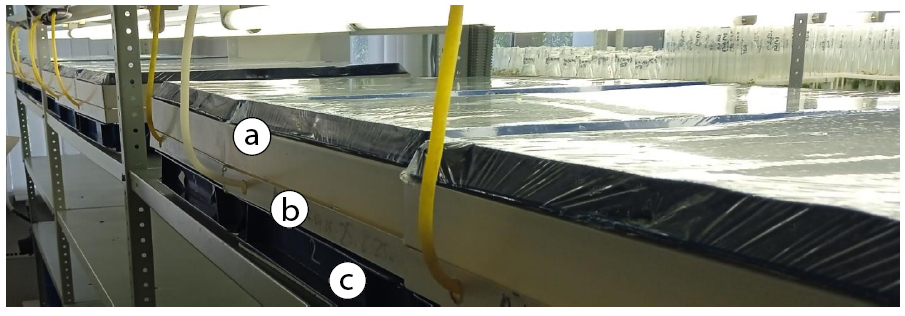
Construction of a flow-through hydroponic system: a - hydroponic tray, b - frame with non-woven fabric, c - translucent cover.
3. RESULTS AND DISCUSSION
3.1. Principles of Propagation of Plant Material for the Experiment that was Required
To follow the accepted research concepts, great attention was paid to obtaining a sufficient quantity of material for subcultivation. For this purpose, the number of proliferating units for each cultivar was maintained at the level of 120–140 tubes per month. Typically, 20 test tubes with an average multiplication coefficient of 6.0 at the end of each proliferation subcultivation were sufficient to form the total volume of material for the next subcultivation. The remaining material (approximately 100 tubes of each cultivar) was transplanted into 40–50 flasks for elongation. It is known that to stabilize shoot formation and ensure the production of well-developed microplants during the elongation stage, it is necessary to monitor the microplants’ illuminance and maintain it at a level of at least 6–7 klx.
The most important elongation outcome was the production of shoots (microcuttings) with a 2–5 mm base diameter and normally developed leaves 3–5 cm long. The number of such microcuttings amounted to 3–4 pieces per flask. This resulted in an opportunity to receive 120–200 microcuttings of each cultivar monthly, indicating the efficiency of rooting and the suitability of the material for subsequent operations. The principle for microcutting differentiation was based on previous research, where it was found to be counterproductive to use microplants that were less developed than the described ones. Rhizogenic activity was normally observed 5–8 days after transplantation onto a nutrient medium with 1.0 mg L−1 IBA in the case of microcuttings of all studied cultivars.
The present study shows that continuous contact with auxin contributed to thickening of the shoot bases due to active root and callus formation, especially in microcuttings with a base diameter of more than 2 mm. Presumably, this improved the nutrition of the developing leaves and stems, which promoted plant growth. However, the maintenance of rooted microplants on a nutrient medium supplemented with auxin for more than 1–1.5 months negatively affected their subsequent viability. The reason for this was that a so-called dedifferentiation effect occurred in cells of the root epidermis, causing their subsequent destruction, which led to further microplant loss. A similar consequence of long-lasting contact of plant tissues with auxins is well-known, expected, and requires proper and timely management.
The acclimatization of such microplants, especially under insufficient illumination levels, can take 2–3 months and be accompanied by the development of competitive pathogenic microflora, leading to a decrease in the survival rate of rooted microplants to 20–30% or even less. At the same time, such plants require mandatory manual care, which is very complicated and time-consuming, even for small quantities. This care cannot be terminated until the plants are transferred to a greenhouse or planted in the open field, where they can develop relatively independently under appropriate conditions.
3.2. Features of Using Vegetating Buds for Transplantation
The discussed set of issues led to a revision of the principles of working with the plant material obtained during periods that are unfavorable for acclimatization. It was decided not to acclimatize each batch of microplants after rooting, but to periodically transplant them with an interval of 1.5–2 months onto a fresh nutrient medium in the form of vegetating buds. To obtain them, as indicated in the methods, we completely removed the already formed leaves and roots from the microplants (Fig. 2).
This approach allows working individually with specific plants, rather than with the general mass of material, the propagation outcome of which is difficult to predict. Transplantation onto a rehabilitation nutrient medium containing 0.1 mg L−1 IBA ensured the successful recovery of leaves and roots on all vegetating buds (Table 1, Fig. 3a).
| Strawberry Cultivar | The Number of Days After Planting Before the Start of Vegetative Organs Recovery | Morphometric Parameters of Microplants After Planting On | Survivalrate, %) | ||||
|---|---|---|---|---|---|---|---|
| Tenth Day | Thirtieth Day | Tenth Day | Thirtieth Day | ||||
| Leaves | Roots | Number of Leaves, pcs | Number of Roots, pcs. | ||||
| Kimberly | 3-5 | 10-12 | 1,9 | 5,4ns | 1,1 | 5,8b | 100 |
| Asia | 3-6 | 10-12 | 1,6 | 5,2ns | 0,9 | 5,4ab | 100 |
| Florence | 5-7 | 12-14 | 1,1 | 4,9ns | 0,4 | 4,5a | 100 |
Note: *Means followed by different letters in the column differ from Duncan’s multiple range test (P<0.05).
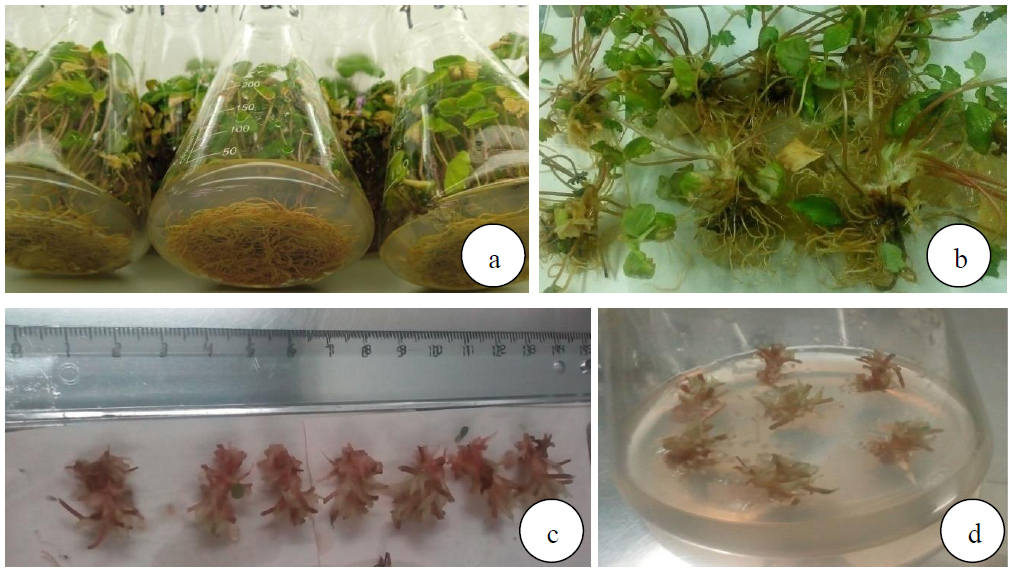
Algorithm for carrying out the rehabilitation of the material: plants after 1.5 months of cultivation on a rehabilitation medium (a), the contents of 1 flask before preparing “vegetating buds” (b), “vegetating buds” prepared for planting (c), and planted (d) for the next rehabilitation (Kimberly cultivar).
Vegetating buds 10 days (a) and 30 days (b) after planting for rehabilitation (Florencecultivar).
Recovery (rehabilitation) took up to 30 days, which corresponds to the duration of subculture for propagation, and the survival rate of vegetating buds amounted to 100% for all cultivars. By the end of the observation, there were no significant differences recorded in the development parameters of microplants of the studied cultivars. The rehabilitation of the Florence cultivar proceeded slower, but it should be noted that its microcuttings were initially objectively less developed.
3.3. Acclimatization of Strawberry Microplants in Flow-through Hydroponic Conditions
Taking into account the seasonal increase of light flux in the temperate climate zone at the end of February, the acclimatization of microplants was planned for this period. It is well known that strawberry shoots can root easily and quickly form new crowns when in contact with moist soil or substrate ex vitro. Therefore, flow-through hydroponics was used in order to model similar conditions during microplants’ acclimatization. A non-woven fabric fixed in a frame above the nutrient solution was used as a wet supporting surface. An advantage of working with strawberry microplants is that the crown form of their shoots eliminates the need for vertical positioning. The leaf rosette serves as a natural support for microplants, simplifying the planting process and preventing excessive immersion in the nutrient solution. After planting, only the roots come into contact with the solution, while the leaves remain above the surface of the non-woven fabric in a high-humidity condition, which eliminates the need for additional moisturizing and simplifies care.
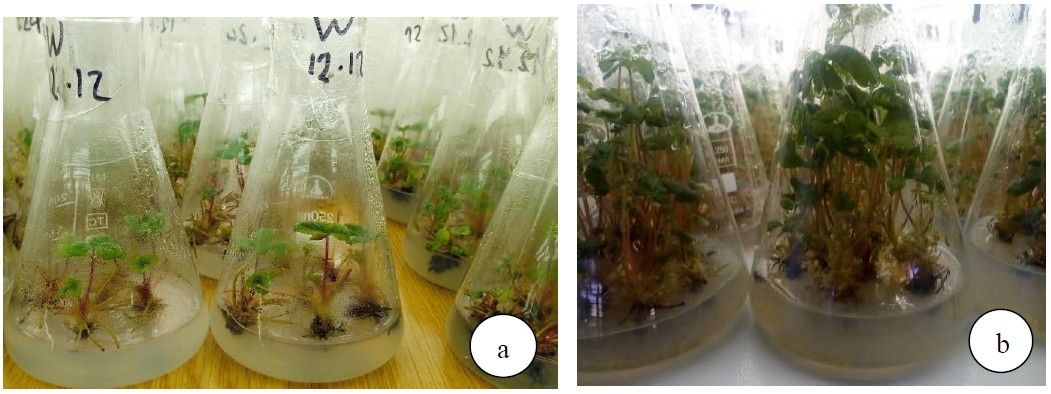
Observations did not reveal significant differences in plants’ growth parameters during acclimatization of microplants of different cultivars in flow-through hydroponic conditions. The microplants of the Kimberly and Asia cultivars developed slightly more dynamically than the Florence cultivar, but the latter were initially weaker, with lower height and weight indices. In general, according to the studied parameters, the Kimberly cultivar stood out, with the increase in plant height and root length significantly exceeding the measurements of other cultivars. At the end of the acclimatization period, the Asia microplants had the highest weight, although the increase in this parameter relative to the starting value turned out to be significantly lower than in other cultivars (Table 2, Fig. 4).
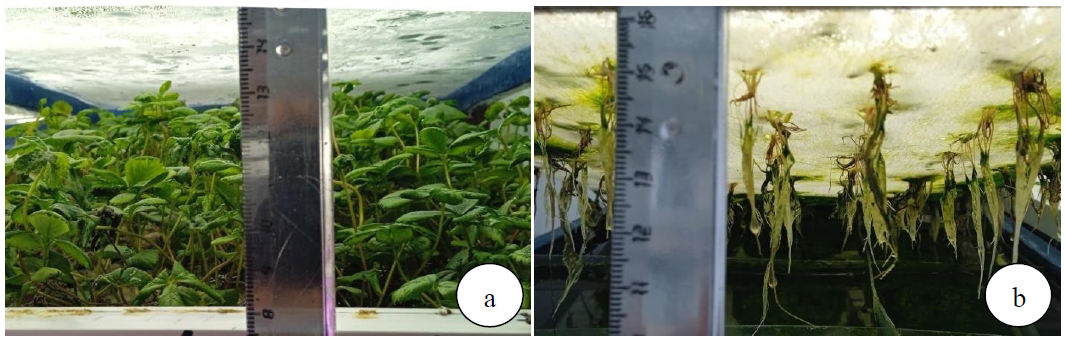
General appearance of microplants at the end of the acclimatization period (a) and the root system of acclimatized plants (b) (Florence cultivar).
| Morphometric Parameters of Microplants | Moment of Measurement | Strawberry Cultivar | ||
|---|---|---|---|---|
| Kimberly | Asia | Florence | ||
| Plant height, cm | When planting in hydroponics | 4.0 | 4.2 | 3.8 |
| after 1 month of acclimatization | 9.9 | 8.5 | 7.9 | |
| Parameter increment, % | - | 147b | 102a | 107a |
| root length, cm | When planting in hydroponics | 2.8 | 2.9 | 3.4 |
| After 1 Month of acclimatization | 6.5 | 5.9 | 6.8 | |
| Parameter increment, % | - | 132b | 103a | 100a |
| plant weight, g | When planting in hydroponics | 0.8 | 1.1 | 0.7 |
| after 1 monthofacclimatization | 2.1 | 2.5 | 1.9 | |
| Parameter increment, % | - | 162b | 127a | 171b |
| survivalrate, % | - | 100 | 100 | 100 |
Note: *Means followed by different letters in the column differ from Duncan’s multiple range test (P<0.05).
Based on the results obtained, it should be noted that the most significant outcome of the experiment is a high survival rate (reaching 100%) of microplants during the acclimatization process, which is impossible to achieve in the case of large-scale acclimatization according to the traditional scheme of using solid substrates. Figure 3b clearly shows that roots formed during the acclimatization process are well developed, characterized by a lighter tone and greater length, which appear to be the basis for the high survival rate.
CONCLUSION
The developed alternative strategy for strawberry clonal micropropagation allows for predicting the production outcome of acclimatized microplants throughout the calendar year with a high degree of accuracy. The estimated quantity of such material can be compactly stored in a lighted tissue culture room, significantly saving time and resources. This can be achieved because microplants are well-preserved in a viable state as vegetating buds until the moment favorable for acclimatization. After synchronizing the rehabilitation cycles, microplants can be simultaneously transferred for acclimatization onto flow-through hydroponics.
An obvious reduction in the process complexity during microplants’ acclimatization to non-sterile conditions is achieved by avoiding the use of any solid substrate. This eliminates the need for its preliminary energy-intensive preparation through heat sterilization to remove pathogenic microflora. The transplantation of microplants was also greatly simplified by reducing the involvement of highly qualified personnel. The high microplants’ viability during the acclimatization period is ensured by the immersion of plant roots in water containing the necessary mineral salts, which periodically circulates in a closed hydroponic system.
AUTHORS’ CONTRIBUTIONS
The authors confirm contribution to the paper as follows: S.K.: Study conception and design; U.T., Z.S.: Data collection; V.B.: Analysis and interpretation of results; S.K.: Draft manuscript. All authors reviewed the results and approved the final version of the manuscript.
LIST OF ABBREVIATIONS
| MS | = Murashige and Skoog medium |
| IBA | = Indolebutyric Acid |
| BAP | = 6-benzylaminopurine |
AVAILABILITY OF DATA AND MATERIALS
The data and supportive information are available within the article.
FUNDING
This publication was prepared with the support of the Ministry of Science and Higher Education of the Russian Federation (project number FSSF-2023-0014).
ACKNOWLEDGEMENTS
Declared none.