All published articles of this journal are available on ScienceDirect.

Biodegradation of Pharmaceuticals and Personal Care Products (PPCPs): A Current State of Knowledge
 Neha Negi2
Priyanka Adhikari3 , *
iD
Sharfaa Hussain2
Dinesh Chandola4
Neha Negi2
Priyanka Adhikari3 , *
iD
Sharfaa Hussain2
Dinesh Chandola4
Authors Info & Affiliations
Abstract
PPCPs have emerged as a significant class of environmental contaminants due to their extensive global consumption and persistence in natural ecosystems. Conventional wastewater treatment plants are often unable to completely remove these compounds, resulting in their continued release into aquatic and terrestrial environments. The bioaccumulation and long-term persistence of PPCPs raise serious concerns regarding potential ecological risks, disruption of microbial communities, and adverse impacts on human health through food chains and water reuse. This review provides a comprehensive synthesis of current advances in the biodegradation of PPCPs, with a particular focus on microbial degradation pathways. The roles of diverse microbial groups, including bacteria, fungi, and algae, as well as specific enzymatic systems, in the transformation and mineralization of PPCPs are critically examined. Special emphasis is placed on ligninolytic fungi, whose extracellular oxidative enzymes, such as laccases, peroxidases, and oxidoreductases, show high potential for degrading structurally complex PPCPs. Furthermore, the application of genetically engineered microorganisms is discussed as a promising strategy to enhance biodegradation efficiency by tailoring metabolic pathways. The review also evaluates environmental and physicochemical factors such as pH, temperature, redox potential, and the molecular properties of PPCPs that influence degradation outcomes. Beyond laboratory findings, advanced biotechnological innovations and decentralized on-site treatment technologies for soil and water systems are highlighted as practical approaches for sustainable remediation. By consolidating recent research findings, this work not only identifies existing challenges and knowledge gaps but also outlines future directions and integrated strategies toward effective, eco-friendly, and scalable PPCP mitigation.
1. INTRODUCTION
PPCPs comprise a diverse group of synthetic and naturally derived chemical substances extensively used in human and veterinary healthcare, agriculture, aquaculture, cosmetics, and personal hygiene. This category includes antibiotics, analgesics, hormones, antiseptics, sunscreens, lotions, and fragrances. The global demand for PPCPs has escalated due to increasing population, expanding healthcare systems, and intensified agricultural and aquacultural practices [1-3]. As a result, PPCPs are now considered prominent emerging contaminants due to their frequent detection in diverse environmental matrices, even at ultra-trace concentrations, and their potential to disrupt ecological and human health (Fig. 1). Therefore, for a better understanding of current research trends and thematic focus areas in the field of PPCPs, a bibliometric analysis was performed using VOS viewer (Fig. 2) over recent years [4].
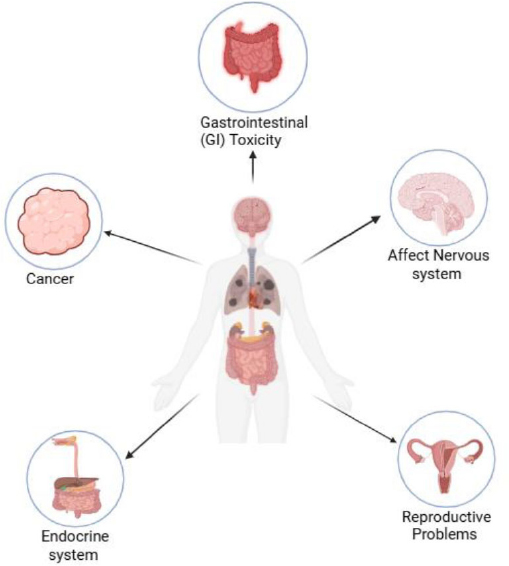
Potential human health impacts of exposure to PPCPs.
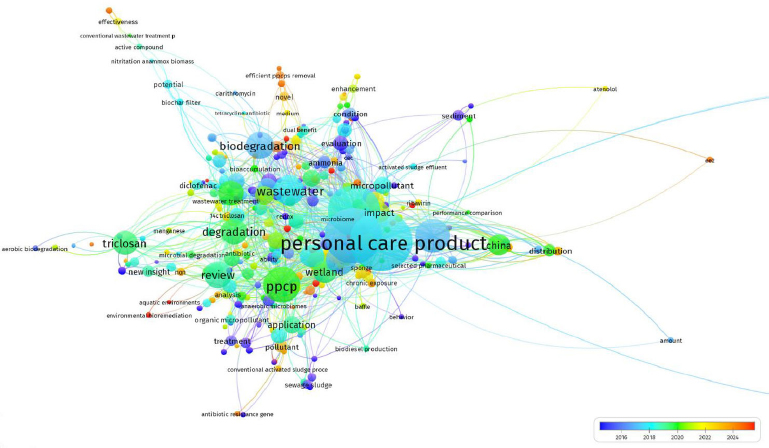
Bibliometric analysis of current research trends in the field of PPCPs.
PPCPs enter the environment through a combination of direct and indirect pathways. Direct sources include discharges from pharmaceutical manufacturing facilities, hospitals, and domestic wastewater effluents. Indirect routes involve the application of biosolids and reclaimed wastewater in agriculture, surface runoff, landfill leachates, and atmospheric deposition [5, 6]. Despite partial removal in conventional Wastewater Treatment Plants (WWTPs), many PPCPs persist due to their resistance to biodegradation and their continuous input into the environment, leading to pseudo-persistence [7, 8].
Once released, PPCPs undergo complex fate processes, such as sorption to sediments, hydrolysis, photodegradation, and microbial transformation, depending on their physicochemical properties. Sediments often serve as sinks for hydrophobic compounds, while irrigation with PPCP-contaminated wastewater facilitates their accumulation in terrestrial ecosystems [9, 10]. Advances in analytical technologies, particularly high-resolution techniques like LC-MS/MS and GC-MS/MS, have significantly improved the ability to detect PPCPs and their transformation products at nanogram-per-liter levels in water, sediment, and biota [3, 11].
Although typically found at low concentrations, PPCPs can elicit significant biological responses in non-target organisms, including endocrine disruption, behavioral alterations, toxicity, and the induction of antibiotic resistance genes [4, 12]. Furthermore, the persistence of antibiotic residues in aquatic systems poses a major threat to public health through the promotion of antimicrobial resistance [9, 13]. In response to these concerns, significant efforts are underway to evaluate the environmental fate of PPCPs and to develop efficient removal strategies for PPCPs. Conventional WWTPs are inadequate for complete removal, necessitating the exploration of advanced treatment technologies, including ozonation, activated carbon, and membrane filtration. However, biodegradation, especially microbial degradation, is increasingly recognized as a cost-effective and environmentally sustainable strategy for the removal of PPCPs [7, 10]. This review provides current knowledge on the biodegradation of PPCPs, with particular emphasis on microbial degradation mechanisms, environmental distribution, advanced analytical techniques, and emerging biotechnological approaches. The objective is to highlight recent progress and identify critical research gaps essential for improving environmental management and regulatory frameworks.
2. METHODOLOGY
A systematic literature search was conducted to identify peer-reviewed articles related to the biodegradation of PPCPs. The Web of Science (WoS) Core Collection databases were selected as the primary search platform due to their comprehensive coverage of environmental science, microbiology, and biotechnology literature. The search was performed from January 2016 to December 2025, ensuring the inclusion of the most recent advances in the field. The following keyword combinations were used to retrieve relevant articles: (“PPCPs biodegradation” OR “emerging contaminants degradation” OR “bacterial degradation” OR “fungal degradation” OR “algal degradation”) AND (“enzymatic degradation”). The search was limited to the “title,” “abstract,” and “keyword” fields, and only publications written in English were considered. Articles were included if they: (i) focused on the biodegradation or biotransformation of PPCPs by microorganisms (bacteria, fungi, algae, or their enzymes); (ii) reported original research, reviews, or case studies with quantitative or qualitative degradation data; (iii) addressed degradation mechanisms, pathways, or influencing environmental factors; and (iv) were published in peer-reviewed journals or conference proceedings. Exclusion criteria were: (i) studies focusing solely on abiotic degradation (e.g., photolysis, hydrolysis without microbial involvement); (ii) articles not available in English; (iii) editorials, commentaries, or non-peer-reviewed reports; and (iv) studies on heavy metals or conventional pollutants without relevance to PPCPs.
The initial search yielded 847 records. After removing duplicate entries (n = 163), 684 articles were screened based on title and abstract. Of these, 421 records were excluded as they did not meet the inclusion criteria, primarily due to a lack of focus on microbial degradation or PPCP-specific compounds. The remaining 263 full-text articles were assessed for eligibility, resulting in the exclusion of an additional 89 articles (reasons: no original degradation data [n = 34], non-English text [n = 12], unavailable full text [n = 18], or off-topic focus [n = 25]). Consequently, 174 studies were included in the final qualitative synthesis. The relatively low number of studies on certain PPCP classes and degradation mechanisms reflects identified knowledge gaps, which are discussed in subsequent sections. Furthermore, for the visualization of research trends and thematic clusters, the retrieved publication data (including titles, abstracts, author keywords, and citation information) were exported from WoS and analyzed using VOSviewer (version 1.6.17). Co-occurrence analysis of keywords and term mapping was performed to identify major research hotspots, emerging topics, and collaborative networks within the PPCPs biodegradation literature.
3. DEGRADATION OF PPCPS
The microbial degradation of PPCPs represents a critical pathway for their natural attenuation in the environment. Among microbial degraders, bacteria and archaea play central roles due to their metabolic versatility and ecological ubiquity. These microorganisms possess enzymatic systems capable of transforming or mineralizing diverse PPCP compounds, thereby reducing their persistence, bioaccumulation potential, and toxicity [7, 10].
3.1. Bacteria
The microbial degradation of PPCPs and their metabolites, especially by bacteria, poses considerable challenges, as many pharmaceutical compounds are synthetically designed to be resistant and even toxic to microbial life [14]. Nonetheless, some native bacterial strains have demonstrated the ability to utilize these compounds as carbon and nitrogen sources, thereby facilitating their degradation in the environment. Figure 3 illustrates the biodegradation of PPCPs over the last 10 years.
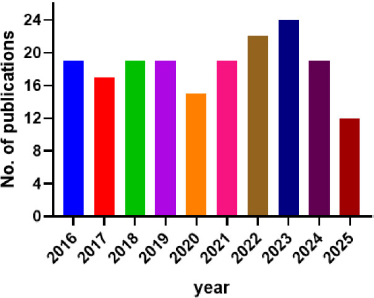
Last 10 years' publications on PPCPs degradation.
Several studies have demonstrated the effective degradation and biotransformation of PPCPs in aquatic environments by diverse microorganisms, including Pseudomonas putida, Geobacillus thermocatenulatus, Bacillus badius, Escherichia coli, Bacillus cereus, Rhodococcus rhodochrous, Exiguobacterium sp. RD3, and the white-rot fungus Phanerochaete chrysosporium. These organisms exhibit significant potential for the removal of PPCPs and their metabolites from water systems [15]. For instance, heterotrophic bacteria are capable of converting compounds such as clofibric acid, 4-chlorophenol, and α-hydroxyisobutyric acid into simpler molecules like lactic acid [16]. Certain bacterial strains show high degradation efficiency, transforming PPCPs into less toxic or non-toxic metabolites. One study showed that Pseudomonas putida completely degraded 100 mg L−1 of salicylic acid within 8 hours under in vitro conditions [17]. Moreover, under ammonia-limited conditions, Pseudomonas species exhibit co-metabolic degradation activity, utilizing enzymes like ammonia monooxygenase to oxidize various pharmaceutical compounds [18].
In another example, Pseudomonas strains isolated from polluted sites were able to degrade up to 47% of carbamazepine via enzymatic oxidation involving cytochrome enzymes. Additionally, Achromobacter denitrificans PR1 demonstrated a remarkable ability to degrade various sulfonamide drugs, achieving removal rates of 98% for sulfamethoxypyridazine, 100% for sulfamethazine, 47% for sulfathiazole, 98% for sulfasalazine, 48% for sulfamethoxine, and 100% for sulfapyridine within 56 hours [18]. However, this strain exhibited no degradative activity toward hypoglycemic agents, sulfacetamide, or sulfur-based diuretics. Interestingly, A. denitrificans PR1 also transformed the aniline ring structure into 3-amino-5-methylisoxazole as a metabolic byproduct. Other bacterial groups, such as Pseudomonas spp. and members of the Proteobacteria phylum, have been reported to degrade sulfamethoxazole in aquatic environments [19]. Details of some microorganisms that play a major role in PPCP degradation are given in Table 1.
| PPCPs Compound | Microorganism(s) | Key Enzyme(s) | Specific Mode of Action | References |
|---|---|---|---|---|
| Diclofenac | Pseudomonas putida, Rhodococcus rhodochrous, Trametes versicolor | Laccase, Cytochrome P450 | Oxidative hydroxylation and ring cleavage via laccase-mediated one-electron oxidation | [19, 102-106] |
| Ibuprofen | Sphingobium sp., Bacillus thuringiensis | Monooxygenase, Dioxygenase | Hydroxylation followed by β-oxidation and aromatic ring cleavage | [107-109] |
| Naproxen | Planococcus sp., Aspergillus niger | Laccase, Peroxidase | Demethylation and subsequent aromatic ring oxidation | [110] |
| Carbamazepine | Phanerochaete chrysosporium, Pleurotus ostreatus | Lignin peroxidase, Manganese peroxidase | Epoxidation and oxidative ring cleavage via ligninolytic enzymes | [103, 111-114] |
| Sulfamethoxazole | Achromobacter sp., Microbacterium sp. | Monooxygenase, Hydrolase | Hydroxylation and cleavage of sulfonamide bond | [111-113] |
| Acetaminophen | Pseudomonas sp., Bacillus sp., Trametes versicolor | Peroxidase, Laccase | Oxidation to quinone intermediates followed by ring cleavage and mineralization | [86, 114] |
| Bisphenol A (BPA) | Sphingomonas sp., Bacillus subtilis, Phanerochaete chrysosporium | Laccase, Cytochrome P450 | Oxidative cleavage of phenolic rings and formation of quinone intermediates | [19, 103-105] |
| Estriol / Steroidal compounds | Pseudomonas sp., Mycobacterium sp. | Hydroxysteroid dehydrogenase, Monooxygenase | Oxidation of hydroxyl groups and steroid ring cleavage | [104-106] |
3.2. Fungal Degradation of PPCPs
One significant environmental challenge worldwide that can also affect our health is the discharge of inadequately treated or untreated wastewater containing various chemicals, including PPCPs, into aquatic ecosystems. An alternative to conventional methods that is both affordable and effective is using fungi to treat wastewater containing these refractory chemicals. Fungal degradation of PPCPs is an environmentally friendly method for reducing the threats posed by contaminants. Fungi have been found worldwide to reduce chemicals, both organic and inorganic. Utilizing fungi, especially the white-rot fungi, is a new method for the efficient breakdown of PPCPs. The key advantage of white-rot fungi over bacteria is their ability to degrade PPCPs via extracellular Lignin-Modifying Enzymes (LMEs), which do not require uptake of the pollutant into the cell, thus reducing toxicity effects [20-26]. Fungi mainly work via altering the chemical composition or by controlling the chemical's bioavailability in wastewater [27]. Basidiomycete fungi, particularly White-Rot Fungi (WRF) such as Trametes versicolor, possess extracellular lignin-modifying enzymes that degrade the lignin structure [28]. Furthermore, ascomycete fungi like Aspergillus niger also contain these enzymes [29]. These are also found in zygomycete fungi like Rhizopus oryzae [30]. However, activity levels vary widely: laccase production in T. versicolor is 10-20 times higher than in Aspergillus niger, making basidiomycetes the preferred choice for most PPCPs remediation studies.
3.3. Biodegradation of PPCPs by Ligninolytic Fungi
Among fungi, ligninolytic fungi are the ones that are widely used for the degradation of PPCPs in wastewater. Various studies have been conducted on the ability of ligninolytic fungi for the treatment of PPCPs present in the waste effluent [31]. A study has been conducted on six ligninolytic fungi, i.e., Trametes versicolor, Ganoderma lucidum, Irpex lacteus, Stropharia rugosoannulata, Gymnopilus luteofolius, and Agrocybe erebia, on their capacity to eliminate and decompose six recalcitrant pharmaceutical micropollutants, namely Carbamazepine (CBZ), Venlafaxine (VFX), Iopromide (IPD), Diclofenac (DCF), Cyclophosphamide (CFD), and Ifosfamide (IFD). The biodegradation efficiency exceeded 90% for IPD using G. luteofolius and was greater than 70% for CBZ with S. rugosoannulata, highlighting the strong potential of this alternative biological treatment approach [32].
The ability of filamentous fungi Trichoderma to remove the fluoroquinolone antibiotics Ciprofloxacin (CIP) and Ofloxacin (OFL), and Climbazole (CLB), a fungicide in liquid, was also reported, in that study they found that T. harzianum was more effective against CLB, with a 91% degradation rate, whereas T. asperellum was more effective against CIP, with an 81% degradation rate after 13 days of incubation. However, both strains demonstrated the same effectiveness, with a degradation rate of about 40% for OFL. It has been observed that whole-cell WRF or their extracellular Lignin-Modifying Enzymes (LMEs) can effectively degrade PPCPs that are resistant to traditional activated sludge processing [33].
The removal of hydrophilic and persistent PPCPs such as naproxen, ketoprofen, and carbamazepine by whole-cell WRF treatment primarily occurs through the combined actions of extracellular and intracellular enzymes, along with sorption onto fungal biomass [34]. Four white-rot fungi, Trametes versicolor, Irpex lacteus, Ganoderma lucidum, and Phanerochaete chrysosporium, were evaluated for their ability to degrade carbamazepine, ibuprofen, and clofibric acid. After 7 days of incubation, all four strains effectively degraded ibuprofen, whereas carbamazepine and clofibric acid were markedly more resistant. Notably, only T. versicolor demonstrated substantial degradation of both of these compounds [35]. The effectiveness of white-rot fungi has also been demonstrated for Bjerkandera sp. R1, Bjerkandera adusta, and Phanerochaete chrysosporium, which were able to completely degrade PPCPs from diverse therapeutic classes, including antidepressants (citalopram), antibiotics (sulfamethoxazole), anti-inflammatory drugs (diclofenac, ibuprofen, and naproxen), and antiepileptics (carbamazepine) [36]. T. versicolor has also been employed for the treatment of hospital wastewater in a fluidized bed bioreactor system, where complete degradation of analgesic compounds was observed following treatment. Most of the antibiotics, recalcitrant drugs, and disruptor drugs were also removed by 75-80% after the treatment [37].
3.4. Biodegradation of PPCPs by Non-ligninolytic Fungi
Most of the studies conducted on the biodegradation of PPCPs in the waste effluent are on ligninolytic fungi. However, researchers have now started exploring the potential of non-ligninolytic fungi to degrade different toxic compounds present in the wastewater. For detoxification of xenobiotics, P450s play a major role in non-ligninolytic fungi. For diclofenac degradation, Penicillium oxalicum (ascomycete) significantly reduced toxicity, but its degradation rate (60% in 10 days) was lower than that of T. versicolor (85% in 7 days) [38]. The advantage of non-ligninolytic fungi is their higher tolerance to high-strength wastewater (e.g., hospital effluent), where LMEs are often inhibited, but their slower kinetics and narrower substrate range remain limitations.
3.5. Microalgal Degradation of PPCPs
Currently, a wide range of pollutants with various characteristics and properties discharged from the residential, industrial, and agricultural sectors are being bioremediated using microalgae. The use of biomass as a feedstock for biodiesel or other biofuel production is another advantage of microalgae-mediated treatment over conventional water treatment plants [39]. A study conducted by Xiong et al. [40] looked at the ability of the green microalga S. obliquus to treat wastewater that had been contaminated with doxylamine. The findings indicated that S. obliquus can thrive in the experimental environment. S. obliquus demonstrated high removal capacities for doxylamine, COD, TN, and TP, suggesting it could be used to treat wastewater contaminated with doxylamine.
Xie et al. [41] reported that Chlamydomonas sp. Tai-03 effectively removed CIP and Sulfadiazine (SDZ), achieving optimal removal efficiencies of 100% and 54.53%, respectively, while achieving a carbohydrate productivity exceeding 1000 mg L-1. In addition, several studies have investigated personal care product contaminants, including Climbazole (CBZ), a widely used antibacterial and antifungal agent in personal care formulations. Pan et al. [42] investigated the interactions between CBZ and the freshwater microalga Scenedesmus obliquus, and after 12 days of incubation, S. obliquus removed more than 88% of CBZ across all treatments. Salicylic acid and Diclofenac were also efficiently removed by S. obliquus [43]. Algae species C pyrenoidosa was exposed to triclosan at a concentration of 800 ng m/L for 96 hours. According to Wang et al. [44], the elimination of triclosan from the medium was found to be 77.2%. Gentili et al. [45] found that the freshwater green algae species cultivation reduced the amount of some pharmaceuticals, including beta-blocker atenolol, some antibiotics, antidepressant bupropion, muscle relaxants, and hypertension drugs, etc, present in the wastewater influent. Therefore, algae farming offers new opportunities for cleaning urban wastewater by partially or completely removing PPCPs.
3.6. Enzymatic Degradation of PPCPs
Natural and isolated bacterial and fungal enzymes have been observed as one of the capable and alternative sources for the degradation of PPCPs in the environment (Fig. 4). These enzymes have been efficaciously scaled up from the research laboratory [46] to other fields for competent degradation of PPCPs [47]. Different groups of microorganisms, i.e., bacteria, actinobacteria, and fungi, have the ability to degrade most PPCPs and play an imperative role in their degradation. In a recent study, it was reported that the bacterial community responsible for the degradation of PPCPs is the Proteobacteria or Actinobacteria groups, even though Planococcus and Bacillus genera were also reported. In fungi, the most frequent one is White Rot Fungi (WRF). The very important point is that PPCPs-degrading fungi mainly belong to the Basidiomycota [48]. WRFs degrade toxins through a series of processes, including hydroxylation, oxidation, dehalogenation, deamination, and formylation reactions [49]. WRF groups are reported to effectively reduce numerous PPCPs, e.g., propranolol, atenolol, carbamazepine, clofibric acid, diclofenac [19, 35], ibuprofen, ciprofloxacin, and norfloxacin [50]. They have notable activity of extracellular ligninolytic enzymes. Additionally, three enzymes, i.e., laccase, manganese peroxidase, and lignin peroxidase, are majorly responsible and significant for the degradation of PPCPs in fungi [51-56]. Among bacterial enzymes, cytochrome P450 monooxygenases are versatile but require cofactors (NADH/NADPH), making them less practical for large-scale application [31, 54].
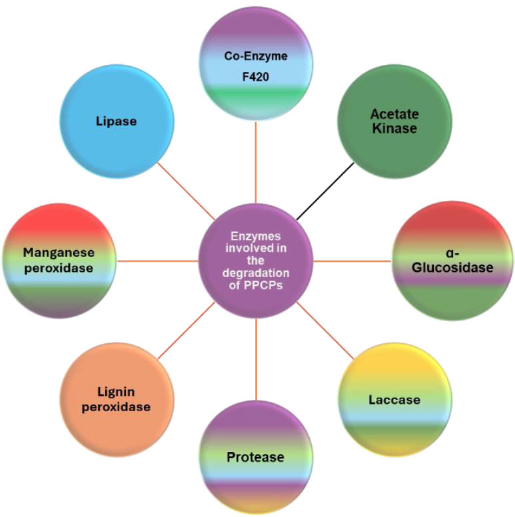
Enzymes involved in the biodegradation of PPCPs.
Among bacterial genera, Pseudomonas spp. is mainly used to degrade compounds like carbamazepine, triclosan, cephalexin, caffeine, and sulfamethoxazole [57-60]. Even though inducible laccase produced by fungi has also been reported [61], Trametes versicolor is one of the greatest and most extensively considered fungi for presenting a large oxidative competence to reduce PPCPs [52]. T. versicolor produces laccases [62]; this particular enzyme has huge potential in numerous biotechnological processes and the manufacturing and development of numerous marketable goods [36]. Nanoparticles formed from the laccase enzyme isolated from Trametes versicolor and Phanerochaete chrysosporium have been reported to remove PPCPs from contaminated water [63, 64]. Another fungus, i.e., Ganoderma lucidum, has been reported for degrade diverse medicines, mainly diclofenac and ifosfamide, due to its ability to produce manganese peroxidase [32, 48, 65]. Fungi Anthracophyllum discolor were reported to degrade fluoranthene, phenanthrene, anthracene, and pyrene using the manganese peroxidase enzyme, with adsorption-immobilization within 24 hours [66].
Lignin peroxidase produced by WRF Phanerochaete chrysosporium was actively reported for the degradation of numerous PPCPs, e.g., 90% Bisphenol A [67]; 75% Rhodamine B and 87% Pyrogallol Red [68]. Other important enzymes, i.e., lipase from the Mucor javanicus (Division Mucoromycota), were verified for the degradation of ibuprofen [69]. The division Mucoromycota can be exploited as a major group of fungi for the degradation of PPCPs in the environment due to their ability to tolerate diverse conditions and the presence of the cytochrome P450 family, which plays a significant role in the metabolism of PPCPs [70]. Although numerous studies have been reported, the large-scale application of enzyme-assisted PPCP degradation remains impractical and challenging, primarily due to high costs. The production of purified enzymes in sufficient quantities for the removal of recalcitrant organic pollutants is economically prohibitive. Consequently, there is a clear need to improve biocatalyst yields while reducing production costs to facilitate viable biotechnological applications. Details of representative enzymes and their associated PPCP degradation processes are summarized in Table 2.
| S.No. | Enzyme Source | Compounds | Degradation % | References |
|---|---|---|---|---|
| ligninolytic enzymes | ||||
| 1 | Pleurotus ostreatus | Remazol Brilliant Blue R | 50% | [115] |
| 2 | Schizophyllum commune IBL-06 | Sandal-fix Black CKF dye, Sandal-fix Turq Blue GWF, Sandal-fix Red C4BLN | 89.6%, 81.46%, 79.6% | [116] |
| 3 | Schizophyllum commune | Sandal Fix Foron Blue E2BLN | 89.71% | [117] |
| 4 | P. chrysosporium | Bisphenol A | 90% | [118] |
| 5 | P. chrysosporium | Rhodamine B | 75% | [68] |
| Laccase enzyme | ||||
| 6 | Trametes versicolor | Alizarin Red S | 100% | [119] |
| 7 | Pycnoporus sanguineus | Bisphenol A | 100% | [120] |
| 8 | Trametes versicolor | Bisphenol A | 100% | [121] |
| 9 | Trametes versicolor | Bisphenol F | 100% | |
| 10 | Trametes versicolor | Bisphenol F | 40% | |
| Manganese peroxidase | ||||
| 11 | Phanerochaete chrysosporium | 2,6-Dimethoxy phenol | 95% | [122] |
| 12 | Anthracophyllum discolor | Pyrene | 86% | [66] |
| 13 | A. discolor | Anthracenne | 65% | |
| 14 | A. discolor | Fluoranthene | 15% | |
| 15 | A. discolor | Phenanthene | 10% | |
| Tyrosinase | ||||
| 16 | Agaricus bisporus | Bisphenol A | 35% | [123] |
| 17 | Mushroom | Phenol | 84% | [124] |
| 18 | Mushroom | p-cresol | 74% | |
| 19 | Mushroom | Phenyl acetate | 90% | |
4. ON-SITE APPROACHES FOR PPCPS BIODEGRADATION
4.1. Treatment of Soil and Sediments
PPCPs have been detected in the soil and sediments in the vadose zone. The vadose zone is an active zone of soil where lithosphere, hydrosphere, and biosphere interact. Therefore, vadose zone soil is important because PPCPs are further transported to the groundwater [71]. The contributions of biodegradation and sorption to the attenuation of pharmaceutical compounds, including acetaminophen, carbamazepine, caffeine, naproxen, and sulfamethoxazole in natural soils have also been reported. The findings indicated that attenuation was strongly influenced by soil characteristics; compounds with a higher affinity for soil were primarily removed through sorption during the first 48 h of soil contact, after which biodegradation became the dominant removal mechanism [72]. However, Al-Rajab et al. [73] have found that soil characteristics have a minor influence on PPCP degradation, and PPCP degradation has been suggested to occur via co-metabolism by Grossberger et al. [74].
A study by Al-Rajab et al. [73] observed that pharmaceutical compounds such as carbamazepine, lamotrigine, caffeine, metoprolol, Sulfamethoxazole, and sildenafil were retained in the soils for a longer time. However, diclofenac, ibuprofen, bezafibrate, gemfibrozil, and naproxen are generally not retained in soils, primarily because of their relatively short half-lives and greater mobility, which facilitate rapid degradation or leaching. Moreover, non-ionic pharmaceutical compounds such as carbamazepine, lamotrigine, caffeine, sildenafil, sulfapyridine, and metoprolol were recalcitrant and accumulated in soils. On the other hand, the weakly acidic pharmaceutical compounds exhibited rapid degradation rates in soil, which is probably due to their chemical structures. For example, carboxylic groups in pharmaceutical compounds often result in rapid microbial degradation [73]. Further, the biodegradation of 14C-ciprofloxacin in water and soil following OECD tests (301B, 307) was investigated by Girardi et al. [75] to compare its fate in both systems.
Ciprofloxacin shows significant mineralization in soil but resists biodegradation in water. Its bioavailability in soil allows for biodegradation, reducing toxicity to microorganisms, while in water, it exhibits lower microbial activity. Although sorption in soil reduces its antimicrobial strength, the compound remains biologically active. Estrone, 17-estradiol, Estriol, and 17-ethinylestradiol are quickly degraded by soil bacteria, with half-lives of 0.6 to 0.8 days under aerobic conditions. Anaerobic soils also show high estrogen breakdown with half-lives of 0.7 to 6.3 [76]. Ciprofloxacin shows significant mineralization in soil but resists biodegradation in water. Its bioavailability in soil allows for biodegradation, reducing toxicity to microorganisms, while in water, it exhibits lower microbial activity. Although sorption in soil reduces its antimicrobial strength, the compound remains biologically active. Estrone, 17-estradiol, Estriol, and 17-ethinylestradiol are quickly degraded by soil bacteria, with half-lives of 0.6 to 0.8 days under aerobic conditions. Anaerobic soils also show high estrogen breakdown with half-lives of 0.7 to 6.3 days [77].
Surprisingly, compared with previously exposed soil, untouched soil had a greater capacity for ibuprofen degradation under anaerobic conditions [78]. Other pharmacological substances, such as diclofenac, are essential non-steroidal anti-inflammatory drugs that are used extensively by both humans and animals to treat pain and inflammation. When added to soils with a wide range of textures (sandy loam, loam, clay loam), diclofenac mineralized quickly and without a lag. The amount of extractable 14C-diclofenac residues declined with half-lives of 5 days over a range of temperature and moisture conditions. Using HPLC, no extractable transformation products were detected. However, mineralization was prevented by heat sterilization in the loam soil, and diclofenac did not dissipate faster when bio-solids were added to sterile or non-sterile soil. According to these results, diclofenac readily biodegrades in agricultural soils [73]. Likewise, the biodegradation of Diclofenac (DCF), Carbamazepine (CBZ), and Triclocarban (TCC) in agricultural soils was observed under aerobic conditions; rapid DCF removal (b7 days) was observed; however, under other redox conditions, only minimal biodegradation was detected. Under aerobic conditions, CBZ and TCC degraded slowly (half-lives of 128-241 and 165-190 days, respectively). When compared to the controls (no DCF), proteobacteria, gemmatimonadales, and actinobacteria phylotypes were substantially more prevalent during DCF biodegradation. Compared with controls, CBZ was enriched in Bacteroidetes, Actinobacteria, Proteobacteria, and Verrucomicrobia, and during TCC biodegradation, actinobacteria and proteobacteria were used [57].
4.2. Treatment of Water
The number of pharmaceutical and personal care products detected in wastewater treatment facilities is not only due to the growth of the pharmaceutical and personal care industries, but also to the advancement in the detection systems [79, 80]. Once these substances enter water bodies, they can be removed by microbial degradation. Additionally, microbial transformation and degradation of PPCPs in water depend on the type of compounds. Microbial degradation can be achieved either by catabolism (use of the organic contaminants as a carbon and energy source) or cometabolism (coincidental transformation of the compound without use as a carbon or energy source. However, the biodegradation of PPCPs by microbes, especially bacteria, is more challenging since the pharmaceuticals are designed and synthesized to be toxic to the bacteria. Nevertheless, it is evident that pharmaceutical effluent can be biodegraded using Bacillus subtilis and Penicillium chrysogenum, and the textile effluent by Salmonella typhi and Penicillium chrysogenum [81].
Yang et al. [31]. studied the levels of various PPCPs in Beijing's Beiyun River, noting concentrations of caffeine, carbamazepine, metoprolol, and others. In India, diclofenac and ibuprofen levels reached 312 ng/L and 1200 ng/L in sewage treatment plants. In another study, persistence of diclofenac was estimated. Diclofenac is one of the most popular non-steroidal anti-inflammatory drugs. A study showed that diclofenac concentrations of 0.09 to 4.0 g L-1 led to bacterial growth with an OD600 of about 1.0-1.3, indicating bacterial growth by consuming diclofenac as a carbon source and subsequently mineralizing it [82]. However, in the presence of glucose, the degradation was intensified. Similar results were also found with the degradation of ibuprofen by the Bacillus thuringiensis B1 in both mono-substrate and cometabolic systems [83, 84]. Microbial strains isolated from sewage sludge were investigated for their ability to degrade diclofenac and carbamazepine, and strain identification was performed using 16S rRNA gene sequencing. Brevibacterium sp. D4 degraded 35% of diclofenac (10 mg L−1) when provided as the sole carbon source; however, supplementation with acetate significantly enhanced biodegradation to 90%. In contrast, Starkeya sp. C11 and Rhizobium sp. C12 degraded approximately 30% of carbamazepine (10 mg L-1) as the sole carbon source, and acetate supplementation did not improve carbamazepine biodegradation [85].
Biodegradation and mineralization of Acetaminophen (ACT) were investigated in an Upflow Fixed-Bed Reactor (UFBR) using a mixed bacterial consortium dominated by Pseudomonas spp. and Bacillus spp. Under H2O2 stimulation, in situ generation of peroxidase was enhanced, facilitating the transformation of acetaminophen into more biodegradable intermediates. The system achieved approximately 99% removal of acetaminophen along with over 72% Total Organic Carbon (TOC) reduction, demonstrating that H2O2 effectively stimulates bacterial peroxidase activity and accelerates ACT biodegradation and mineralization [86]. Thus, the H2O2-stimulated UFBR represents an efficient and practical approach for in situ peroxidase production and enhanced pharmaceutical removal.
In contrast, a fungus-based system utilizing a Scedosporium dehoogii biofilm formed via electrodeposition on the anode has also been explored for acetaminophen degradation. This study demonstrated that S. dehoogii can utilize acetaminophen as a carbon source while simultaneously functioning within a Microbial Fuel Cell (MFC), generating a potential of up to 0.8 V. However, the specific enzymes involved in the degradation process were not clearly identified. Further studies are needed to explore other fungi with superior electrode compatibility and catalytic efficiency for application in MFCs, which are considered promising sustainable energy technologies [87].
The current focus of researchers is to achieve a more detailed characterization of the enzymes involved in PPCP degradation. In this context, the study proposes for the first time that species from the genera Flavobacterium, Dokdonella, and Methylophilus may participate in the degradation of paracetamol metabolites, suggesting a potential role for these genera in paracetamol biodegradation. Earlier research also demonstrated that Pseudomonas putida can completely degrade salicylic acid within 8 hours of treatment [88].
In addition, ammonia-oxidizing bacterial consortia can degrade pharmaceutical contaminants through the action of ammonia monooxygenase, an enzyme produced under ammonia-starvation conditions. Furthermore, Pseudomonas species isolated from contaminated sites have been shown to enzymatically degrade carbamazepine, achieving up to 47% removal [89], sulfonamides groups compounds are found in the waste water effluent can be biodegraded by Achromobacter denitrificans PR1 effectively, such as sulfamethoxypyridazine (98%), sulfamethoxine (48%), sulfamethazine (100%), sulfathiazole (47%), sulfapyridine (100%), and sulfasalazine (98%) in 56 hours of treatment. Nevertheless, this strain cannot degrade the sulfur-containing diuretics such as sulfacetamide and hypoglycemic drugs [90]. Therefore, this is the only strain (A. denitrificans PR1) that has been reported to metabolize the aniline ring of Sulfamethoxazole, yielding 3-amino-5-methylisoxazole in wastewater [91]. The other study has demonstrated that Proteobacteria and the Pseudomonas genus species also degraded a reasonable percentage of Sulfamethoxazole from aquatic systems [92]. Under suitable sulfate-rich, methanogenic conditions, the microbiome effectively degrades naproxen, oxybenzone, and guaifenesin [93]. Some other species, such as Sphingomonas Ibu-2, Sphingomonas PWE1, and Pseudomonas putida DTB, effectively degraded the octylphenol, ibuprofen, and DEET from the contaminated environment [75].
4.3. Treatment with Genetically Engineered Microorganisms (GEMs)
The ability of microbial strains and the biocatalysts they produce to degrade contaminants is constrained by several environmental and growth parameters [75]. Therefore, microorganisms transform the PPCPs through active catabolic enzymes. Advanced genetic engineering methods have made it possible for this genetic material interchange. However, a few important factors must be taken into consideration while using recombinant DNA technology to ensure the successful production of GEMs [15]. These include, among other things, changing the microbial enzymes' specificity and affinity, fully comprehending the design, regulation, and biochemical conversion of processes, developing the bioprocess under observation and control, and most importantly, ensuring that the strain that is produced can function as a chemical and pollutant biosensor with degradation potential [75].
Likewise, the presence of specific genetic elements plays a crucial role in determining the ability of microorganisms and their enzymes to degrade pollutants [15]. Certain plasmids encode specialized catabolic pathways that enable the degradation of specific compounds; however, many plasmids are limited to a narrow range of substrates, often producing enzymes that target a single pollutant or a small group of structurally related compounds [94]. Notable examples include the CAM plasmid for camphor degradation, the OCT plasmid for alkanes such as decane, octane, and hexane, the NAH plasmid for naphthalene degradation, and the XYL plasmid for the breakdown of xylene and toluene [7]. These plasmid-mediated mechanisms have been demonstrated in various field studies for the effective degradation of environmental contaminants. Furthermore, novel plasmids have been identified and engineered from diverse bacterial strains to expand the range of degradable pollutants [95]. In addition, several GEMs have been developed with enhanced degradation capabilities for a wide spectrum of contaminants [75].
For instance, a genetically modified strain of Pseudomonas putida is able to degrade various groups of contaminants, such as xylene, camphor, chlorobenzoate, salicylate, and toluene [96]. GEMs-derived enzymes have attracted significant attention for their enhanced efficiency in bioremediating diverse contaminants. For instance, the plasmid pGEc47B derived from Mycobacterium sp. HXN-1500 encodes the CYP153A6 enzyme, which catalyzes the hydroxylation of alkanes into 1-alkanols. Similarly, the plasmid pRSFDuet-1, when expressed in Bacillus cereus, encodes aldehyde dehydrogenase, an enzyme that facilitates the detoxification and degradation of harmful aldehyde intermediates generated during metabolic processes [97-99].
For instance, P. fluorescens only marginally removes the contaminants from the field under controlled settings. As a result, challenging field circumstances play a crucial role in producing GEMs for biodegradation [100]. E. coli, P. putida, Acinetobacter calcoaceticus, and B. subtilis are a few of the bacterial species that regularly use GEMs with the potential for field-level gene expression. Finding new bacterial strains that can be used as model organisms for the development of GEMs is therefore crucial. The newly created GEMs should be able to live in a variety of environmental settings while expressing the desired genes. To generate high-potential GEMs and address environmental problems using a sustainable method, researchers must focus on these problems [101].
5. CHALLENGES AND RESOLUTIONS
The microbial degradation of PPCPs in aquatic environments poses complex challenges, primarily due to the structural and chemical properties of these compounds. PPCPs are often designed for stability, bioactivity, and resistance to metabolic breakdown, which renders them inherently recalcitrant in natural and engineered environments. Many of these compounds, including antibiotics, antiseptics, and hormones, possess strong antimicrobial properties, thereby exerting toxic effects on microbial communities that would otherwise facilitate their degradation. This toxicity can suppress the growth, metabolic activity, and enzymatic functions of native microbial populations, significantly impeding the biotransformation process.
In addition to their toxicity, PPCPs are frequently present in aquatic systems at trace concentrations, often in the nanogram to microgram per liter range. These sub-inhibitory concentrations may be insufficient to induce the expression of specific degradative enzymes, especially those involved in co-metabolic processes. Co-metabolism, a common mechanism for PPCP degradation, relies on the presence of a primary substrate to support microbial growth and energy metabolism, while PPCPs are degraded incidentally. This dependency complicates the optimization of bioremediation systems, particularly under nutrient-limited or oligotrophic conditions. Moreover, the degradation of PPCPs often leads to the formation of intermediate metabolites, some of which may exhibit equal or greater toxicity than the parent compound.
The accumulation of such metabolites may pose additional environmental and health risks and necessitate complete mineralization for safe removal. Compounding this issue is the limited understanding of the metabolic and enzymatic pathways involved in PPCPs transformation. Although certain bacterial strains, such as Pseudomonas putida, Achromobacter denitrificans, Rhodococcus rhodochrous, and Phanerochaete chrysosporium, have demonstrated the capacity to degrade specific PPCPs, the broader diversity of microbial degraders and their associated genes and enzymes remain underexplored. Environmental parameters, including pH, temperature, dissolved oxygen, redox potential, and microbial community dynamics, also play critical roles in determining the efficiency of microbial degradation. In natural systems and wastewater treatment plants, these variables are often difficult to control, resulting in inconsistent removal efficiencies. Furthermore, conventional activated sludge systems may not provide sufficient residence time or microbial specificity required for effective PPCP degradation.
To overcome these challenges, several strategies have been proposed and developed. One approach involves the enrichment and application of specialized microbial consortia capable of degrading target PPCPs. These consortia may be derived from polluted environments where selective pressure has driven the evolution of degradative capabilities. Bioaugmentation with such consortia, in combination with biostimulation through nutrient or electron donor amendments, can enhance microbial activity and promote the expression of necessary enzymes. Advances in metabolic and genetic engineering further enable the design of microbial strains with optimized degradation pathways and increased resistance to PPCP toxicity. Additionally, the immobilization of microbial cells on solid supports or within polymer matrices offers a means of protecting cells from environmental stressors, extending their functional lifespan, and enhancing biodegradation rates. Coupling biological treatments with physical or chemical processes such as adsorption, advanced oxidation, or membrane filtration can also provide a more comprehensive and robust solution, especially for compounds that are particularly persistent or toxic.
Emerging omics technologies, including metagenomics, transcriptomics, proteomics, and metabolomics, are increasingly being employed to elucidate microbial community structures, identify functional genes, and characterize metabolic pathways associated with PPCPs degradation. These tools provide critical insights into microbial ecology and offer opportunities for the rational design and optimization of bioremediation systems. Furthermore, the development of biosensors and bioindicators capable of real-time monitoring of PPCPs concentrations and microbial activity enables dynamic control and assessment of treatment performance, contributing to more effective and sustainable management of PPCPs-contaminated waters.
5.1. Practical Relevance, Scalability, and Implementation Limitations
Despite encouraging degradation efficiencies reported under controlled laboratory conditions, the translation of PPCPs biodegradation technologies to real-world applications faces several critical barriers. Most published studies are conducted at bench scale (0.1-5 L) using synthetic wastewater and pure microbial cultures; when scaled to pilot or full-scale bioreactors (100-10,000 L), removal efficiencies typically drop by 30-60% due to heterogeneous mixing, oxygen transfer limitations, and competitive microbial interactions [125]. Furthermore, long hydraulic retention times required by fungal systems (7-14 days) demand reactor volumes 3-5 times larger than conventional activated sludge tanks, significantly increasing capital costs [34]. Economic feasibility is another major hurdle: purified oxidative enzymes (laccase, manganese peroxidase) cost $500–$2,000 per gram, making them prohibitive for municipal wastewater treatment where operating budgets are below $0.50 per cubic meter. Whole-cell fungal systems are cheaper ($10-50 per kg biomass) but suffer from slow kinetics and the need for near-sterile conditions to prevent bacterial overgrowth [126]. Immobilized enzyme systems offer reusability (up to 10 cycles) but require complex and costly preparation, limiting their adoption outside specialized industrial applications [127]. In low-resource settings, decentralized on-site technologies such as constructed wetlands and biofilters are often proposed, yet their performance is highly seasonal (30-70% drop in PPCPs removal during winter) and land-intensive (10-20 m2 per person equivalent), while remaining ineffective for persistent compounds like carbamazepine and triclosan [128]. Regulatory and monitoring gaps further impede progress: most countries do not mandate PPCPs removal or toxicity testing of transformation products, so wastewater utilities lack economic or legal incentives to adopt advanced biodegradation methods. Even when degradation is achieved, fewer than 20% of field studies report comprehensive metabolite identification or ecotoxicity assays, leaving potential risks unaddressed [129]. A hidden but critical risk is incomplete mineralization – biodegradation often stops at transformation products that may be more persistent or toxic than the parent compound. For example, diclofenac can be converted to quinone imine intermediates with higher aquatic toxicity, and carbamazepine degradation yields acridine derivatives that resist further breakdown [130]. Complete mineralization, verified by total organic carbon removal or radiolabeled tracer studies, is achieved in fewer than 30% of reported cases even under optimized conditions. Addressing these practical barriers will require hybrid treatment trains (e.g., biodegradation followed by activated carbon or advanced oxidation), context-specific feasibility assessments, and revised regulatory frameworks that include PPCPs and their metabolites. Without such integrated approaches, the gap between laboratory promise and field reality will persist [131].
CONCLUSION
The persistence and ecological ramifications of PPCPs in aquatic environments have emerged as critical concerns in environmental science and public health. These compounds, owing to their chemical stability and biological activity, pose significant challenges to conventional wastewater treatment processes. Microbial degradation offers a promising, eco-friendly solution for the removal of PPCPs and their metabolites; however, its efficacy is often limited by the recalcitrant nature of these contaminants, their low environmental concentrations, and potential toxicity to microbial communities. Recent studies highlight the capacity of specific bacterial and fungal strains, including Pseudomonas putida, Achromobacter denitrificans, Rhodococcus rhodochrous, and others, to metabolize various PPCPs through enzymatic and co-metabolic pathways. Despite these advances, the complete degradation of PPCPs often requires synergistic microbial interactions, optimized environmental conditions, and advanced bioengineering strategies. The integration of omics technologies, metabolic modelling, and hybrid treatment systems represents a forward-thinking approach for enhancing microbial bioremediation.
To realize the full potential of microbial degradation as a sustainable remediation strategy, future research should focus on identifying novel degradative pathways, enhancing microbial resilience through synthetic biology, and developing scalable systems that ensure complete mineralization of PPCPs with minimal ecological risk. A comprehensive understanding of microbe-contaminant interactions, supported by robust monitoring and process optimization, will be pivotal in translating laboratory successes into field-scale solutions. As global usage of PPCPs continues to rise, advancing microbial degradation technologies will be essential to safeguard aquatic ecosystems and human health.
AUTHORS’ CONTRIBUTIONS
The authors confirm their contribution to the paper as follows: P.T.: Conceptualization, writing-original draft, review and editing, methodology, software; N.N.: Writing-original draft; P.A.: Conceptualization, writing-original draft, review & editing, methodology; S.H.: Writing-original draft, review and editing; D.C.: Writing-original draft. All authors reviewed the results and approved the final version of the manuscript.
LIST OF ABBREVIATIONS
| PPCPs | = Personal Care Products |
| WWTPs | = Wastewater Treatment Plants |
| WoS | = Web of Science |
| LEMs | = Lignin-Modifying Enzymes |
| WRF | = White-Rot Fungi |
CONFLICT OF INTEREST
The author Dr. Priyanka Adhikari is an Editorial Advisory Board member of The Open Biotechnology Journal.
ACKNOWLEDGEMENTS
The authors are grateful to their representative universities and institutes for providing literature facilities.